

The Agroalgae project is led by Elvis Kevin Crespin Buestan, a researcher focused on sustainable agriculture in the Galápagos Islands. Since beginning his career in 2013, he has gained experience in agricultural research and laboratory coordination. In 2018, he received a scholarship to study at the I~MAR Research Center in Chile, where he developed skills in organizing and leading scientific activities. He completed his undergraduate studies in 2019 and continues to work on ecological innovations that support biodiversity and reduce chemical use in farming.
Farmers in the Galápagos face several serious challenges, primarily due to the excessive use of chemical fertilizers. These substances contaminate aquifers and coastal waters, leading to eutrophication and causing ecological damage as well as health risks. Their continued use—especially in short-cycle and permanent crops—also prevents the natural recovery of soil fertility, threatening long-term agricultural sustainability.
The automated cultivation of native microalgae enables the production of natural biofertilizers, reducing reliance on chemical fertilizers. This approach supports the creation of pesticide-free food, improves soil and water health, and enhances food quality. It also contributes to biodiversity and the long-term sustainability of the Galápagos Islands. By highlighting a previously overlooked natural resource, the AGROALGAE project promotes environmental restoration and demonstrates to the community the value of adopting a green economy.
- Evaluate the growth of native microalgae isolated from Santa Cruz Island.
- Formulate an agricultural biofertilizer based on these microalgae, specifically designed for short-cycle crops.
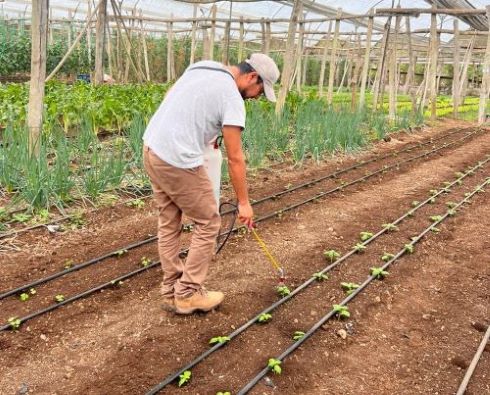
- Apply the biofertilizer within a local agricultural system, focusing on short-cycle cultivation.
- Analyze the positive effects of microalgae on crop growth and development, and share the results with the agricultural community of Santa Cruz Island.
AGROALGAE addresses the following SDGs through a focus on maintaining agricultural productivity using natural, sustainable, and renewable resources like native microalgae:
- SDG 2.3 & 2.4 – Sustainable agriculture and food security By improving soil health and reducing chemical fertilizer use.
- SDG 8.2 – Inclusive and sustainable economic growth By creating green jobs and new income-generating opportunities.
- SDG 9.5 – Innovation and scientific research By developing eco-friendly agricultural technologies.
- SDG 12.2 – Sustainable consumption and production By promoting circular practices and reducing environmental impact.
By mitigating the negative impacts of climate change, AGROALGAE addresses a critical challenge for both the present and the future. Green development depends on active community involvement, which helps deliver essential services, improves well-being, creates green jobs, and reduces poverty.
The project transparently demonstrates to the local community that viable, sustainable alternatives exist for their development. In doing so, it promotes a circular, fair, and solidarity-based economy — strengthening the Galápagos region’s environmental, social, and economic resilience.
| Phase | Activity | Buget |
|---|---|---|
| Phase 1. Internship to contribute to research, crop management, and biofertilizer production. | Maintain the microalgae collection. Scale up microalgae production according to the project's established protocols for mass cultivation. Deliver the biofertilizer to local producers for field evaluation. Collect information to assess the potential effects of the microalgae on various crops. | $1100,00 FINANCED (The value includes 10% of Overhead for the administration of the Co-Galapagos initiative) |
| Phase 2. Selection and maintenance of microalgal strains | To identify and select strains with beneficial characteristics for use as a biofertilizer, and to maintain them under controlled conditions to ensure their purity and viability. | $1100,00 FINANCED (The value includes 10% of Overhead for the administration of the Co-Galapagos initiative) |
| Phase 3: Microalgae cultivation | Prepare and sterilize culture media, inoculate them with microalgae under aseptic conditions, and monitor and adjust parameters such as light, temperature, pH, and nutrients to optimize growth. Subsequently, scale up the culture to a larger volume. | $550,00 REQUIRE FUNDING (The value includes 10% of Overhead for the administration of the Co-Galapagos initiative) |
| Phase 4. 2nd Internship to contribute to research, crop management, and biofertilizer production. | Maintain the microalgae collection. Scale up microalgae production according to the project's established protocols for mass cultivation. Deliver the biofertilizer to local producers for field evaluation. Collect information to assess the potential effects of the microalgae on various crops. | $1100,00 FINANCED (The value includes 10% of Overhead for the administration of the Co-Galapagos initiative) |
| Phase 5: Monitoring and Optimal Concentration of Microalgae for Foliar Application in Orchards | To conduct continuous monitoring of the microalgae culture to ensure that the appropriate cell concentration is reached. Once the optimal concentration is achieved, prepare the biomass for transport and subsequent application in the demonstration farm. | $1100,00 REQUIRE FUNDING (The value includes 10% of Overhead for the administration of the Co-Galapagos initiative) |